
Guide
How to Compare Non-Owner Car Insurance Quotes
A method for finding non-owner coverage: which insurers write it, how to ask, what limits to choose, SR-22 handling, and how to compare prices.

By Dana Whitlock · Staff Writer
Published · Updated
Answer in brief
Not every insurer writes non-owner policies and many do not quote them online, so phone or agent quotes are often necessary. Ask explicitly for a "named non-owner policy". Fix limits first—100/300/100 costs little more than minimums—and add uninsured motorist. If you need an SR-22, say so up front. Gather three or more quotes; prices for identical coverage vary two to one or more because few insurers compete for this niche.
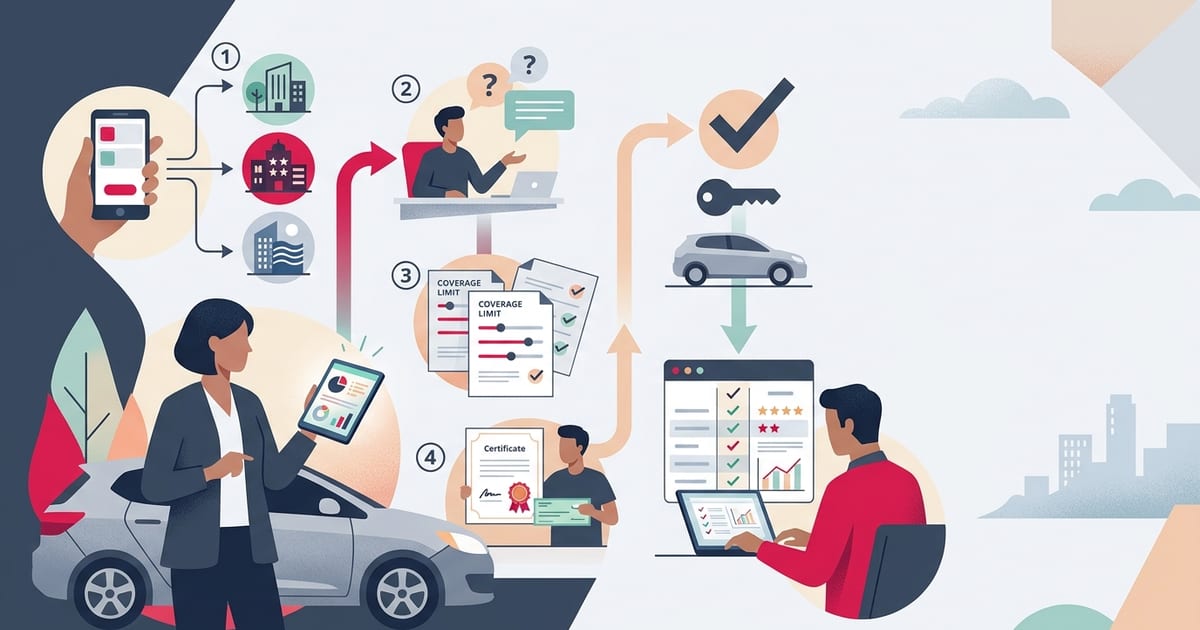
- 1
Confirm eligibility
No car owned by you or regularly available in your household.
- 2
Set limits
100/300/100 with UM/UIM; add MedPay if you lack health coverage.
- 3
Mention SR-22/FR-44
If required, say so first—it narrows the list.
- 4
Quote three or more
A comparison tool plus direct phone quotes; many insurers do not quote non-owner online.
- 5
Normalise
Annual total including filing fees.
- 6
Plan the conversion
Ask how the policy converts if you buy a car.
Quote finder
Find auto insurance quotes that fit your situation
Questions & answers
Can I buy non-owner insurance online?
Some insurers quote it online; many require a phone call or agent.
Which insurers offer non-owner policies?
Many large and regional insurers do, but not all. Comparison tools and agents can identify them for your state.
Do quotes affect my credit?
No. Insurance quotes use soft inquiries.
Terms used in this guide
- Premium
- The price of the policy, per six or twelve months.
- Liability limits
- Maximum payouts, written e.g. 100/300/100 in thousands.
- Non-owner (named non-owner) policy
- Liability coverage for a named driver who does not own a car; follows the driver, not a vehicle.
Sources and references
Legal figures on this page (minimum limits, filing periods, statutory benefits) are checked against the primary law or the state insurance regulator listed below. Links and figures last verified Nov 2026.
- 37 TAC § 25.5 — enforcement of failure to maintain financial responsibility — Texas Administrative Code (via Cornell LII), 37 Tex. Admin. Code § 25.5Primary lawAn SR-22 filed as compliance must be maintained for two years from the most recent qualifying conviction; a lapse re-suspends driving privileges until a new certificate is filed.
- Nine ways to lower your auto insurance costs — Insurance Information InstituteConsumer guidanceShop at least three quotes; raising a deductible from $200 to $500 can cut collision/comprehensive cost 15–30%, $1,000 can save 40%+; drop physical damage on cars worth under 10× the premium; bundling, low-mileage and good-student discounts.
- Consumer insurance information — National Association of Insurance CommissionersConsumer guidancePlain-language guides from the body of state insurance regulators; links to every state's insurance department and complaint process.
- What is covered by a basic auto insurance policy? — Insurance Information InstituteConsumer guidanceDefines bodily injury and property damage liability, MedPay, PIP, uninsured/underinsured motorist, collision, comprehensive and glass coverage.
- What if I can't find auto coverage? — Insurance Information InstituteConsumer guidanceHow the non-standard market and state assigned-risk plans insure drivers the voluntary market declines.
- Car insurance — Consumer ReportsConsumer guidanceIndependent testing organisation's guides to comparing policies and insurers.
- Auto insurance basics — United PolicyholdersConsumer guidancePlain-language coverage explanations from a policyholder-advocacy non-profit.
Practical guidance on this page is original editorial work. Cited sources support factual statements and do not endorse this site. Dollar ranges described as typical or illustrative are editorial estimates, not figures from these sources.
Guide
How Much Non-Owner Car Insurance Costs
Typical non-owner policy premiums by driver profile, why it is cheaper than a standard policy, and what raises the price.
Guide
What Non-Owner Car Insurance Is
Non-owner car insurance explained: liability coverage for drivers who do not own a car, what it includes and excludes, and how it works with the car owner's policy.
Guide
Non-Owner SR-22 Insurance
How to meet an SR-22 or FR-44 filing requirement without owning a car, what the filing does, how long it lasts, and what happens if the policy lapses.