
Guide
Who Needs Non-Owner Car Insurance
The situations where a non-owner policy makes sense: frequent borrowers, drivers maintaining coverage history, SR-22 filers without a car, and people between cars.

By Dana Whitlock · Staff Writer
Published · Updated
Answer in brief
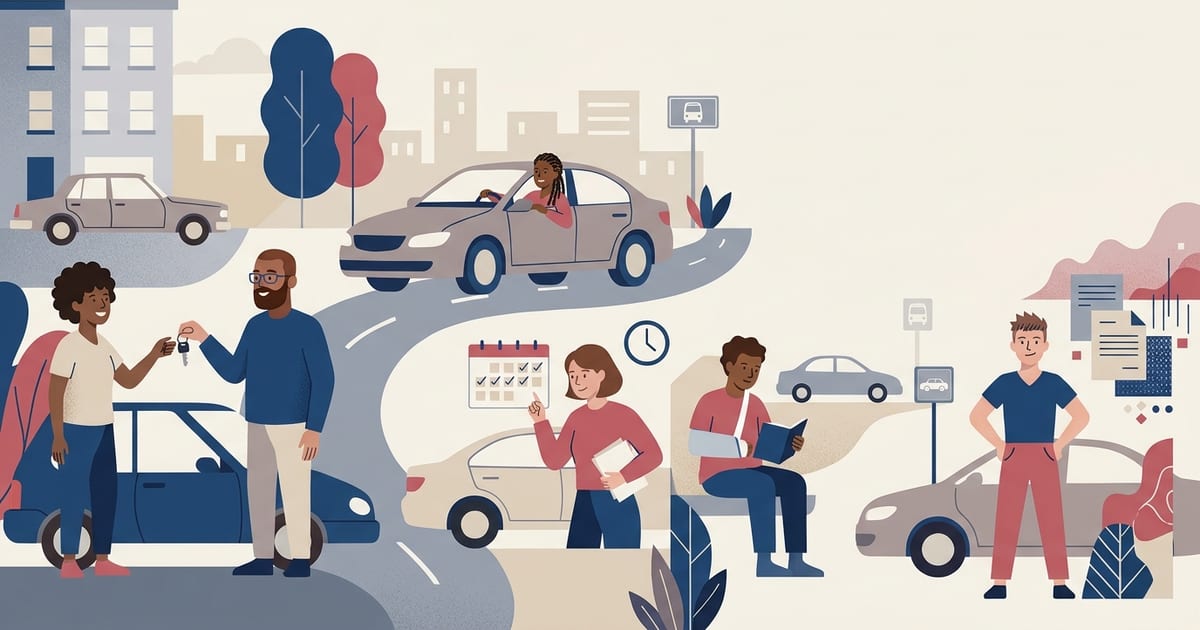
Non-owner insurance fits four groups: drivers who borrow or rent cars regularly and want their own liability protection; drivers who need to file an SR-22 or FR-44 but have no car; people between cars who want to avoid a coverage gap that raises future rates; and drivers who use car-sharing services often and want limits above the service's minimum. It is not needed if you are listed on a household policy or drive only a few times a year.
| Situation | Non-owner policy? |
|---|---|
| Borrow friends'/family cars weekly | Yes—protects you and your savings beyond the owner's limits |
| SR-22 required, no car | Yes—the standard way to file |
| Sold car, buying another in 6+ months | Yes—prevents a lapse surcharge |
| Use car-sharing or rentals monthly | Often—service minimums are low |
| Listed on a parent's or spouse's policy | No—already covered |
| Drive two or three times a year | Usually no |
The coverage-gap reason
Insurers treat a lapse in coverage as a risk signal. A driver with no insurance for six months or more typically pays a no-prior-insurance surcharge—often 10–30%—when buying a car later. A non-owner policy at $300–$700 a year preserves continuous coverage and avoids that.
Protecting assets
If you cause a serious crash in a borrowed car and the owner carries state-minimum limits, the injured party can pursue you for the rest. A non-owner policy with 100/300/100 limits stands between your savings and that judgment.
Entries in this guide
Specific questions answered in more depth.
Questions & answers
Do I need non-owner insurance if I don't drive?
No. It is only useful if you drive borrowed, rented or shared cars.
Is non-owner insurance worth it between cars?
If the gap will be more than about a month and you plan to buy another car, usually yes.
Do I need it if I'm on my parents' policy?
No. You are already covered as a listed driver.
Terms used in this guide
- Continuous coverage
- An unbroken insurance history; gaps raise future premiums.
- SR-22
- A certificate of financial responsibility filed by your insurer with the state after certain violations; typically required for three years.
- Coverage gap (lapse)
- A period with no auto liability coverage; rated as a risk factor for several years.
Sources and references
Legal figures on this page (minimum limits, filing periods, statutory benefits) are checked against the primary law or the state insurance regulator listed below. Links and figures last verified Nov 2026.
- 37 TAC § 25.5 — enforcement of failure to maintain financial responsibility — Texas Administrative Code (via Cornell LII), 37 Tex. Admin. Code § 25.5Primary lawAn SR-22 filed as compliance must be maintained for two years from the most recent qualifying conviction; a lapse re-suspends driving privileges until a new certificate is filed.
- Automobile financial responsibility limits by state — Insurance Information Institute (2023)Statistical dataCompulsory coverages and minimum liability limits by state (table dated December 2023 — several states have raised limits since; see statute entries).
- Insurance losses by make and model — Highway Loss Data InstituteStatistical dataRelative claim frequency and severity by vehicle under collision, property damage, comprehensive, PIP, MedPay and bodily injury coverages.
- What is covered by a basic auto insurance policy? — Insurance Information InstituteConsumer guidanceDefines bodily injury and property damage liability, MedPay, PIP, uninsured/underinsured motorist, collision, comprehensive and glass coverage.
- Nine ways to lower your auto insurance costs — Insurance Information InstituteConsumer guidanceShop at least three quotes; raising a deductible from $200 to $500 can cut collision/comprehensive cost 15–30%, $1,000 can save 40%+; drop physical damage on cars worth under 10× the premium; bundling, low-mileage and good-student discounts.
- Understanding your insurance deductibles — Insurance Information InstituteConsumer guidanceHow deductibles apply to collision and comprehensive and how raising them lowers premium.
- What is gap insurance? — Insurance Information InstituteConsumer guidanceGap coverage pays the difference between a car's actual cash value and the loan or lease balance after a total loss.
- What if I can't find auto coverage? — Insurance Information InstituteConsumer guidanceHow the non-standard market and state assigned-risk plans insure drivers the voluntary market declines.
Practical guidance on this page is original editorial work. Cited sources support factual statements and do not endorse this site. Dollar ranges described as typical or illustrative are editorial estimates, not figures from these sources.
Guide
What Non-Owner Car Insurance Is
Non-owner car insurance explained: liability coverage for drivers who do not own a car, what it includes and excludes, and how it works with the car owner's policy.
Guide
Non-Owner SR-22 Insurance
How to meet an SR-22 or FR-44 filing requirement without owning a car, what the filing does, how long it lasts, and what happens if the policy lapses.
Guide
Insurance When You Borrow Someone Else's Car
How coverage works when you drive a friend's or relative's car—permissive use, whose policy pays, what happens on a claim, and when you should be listed instead.