
Guide
Non-Owner SR-22 Insurance
How to meet an SR-22 or FR-44 filing requirement without owning a car, what the filing does, how long it lasts, and what happens if the policy lapses.

By Dana Whitlock · Staff Writer
Published · Updated
Answer in brief
If your state requires an SR-22 (or FR-44 in Florida and Virginia) to reinstate your licence and you do not own a car, a non-owner SR-22 policy is the standard solution. The insurer files the certificate with the state licensing agency, proving you carry at least minimum liability. The requirement typically lasts three years; the policy must stay continuously in force or the insurer notifies the state and your licence can be suspended again. Expect $500–$1,200 a year depending on the underlying violation.
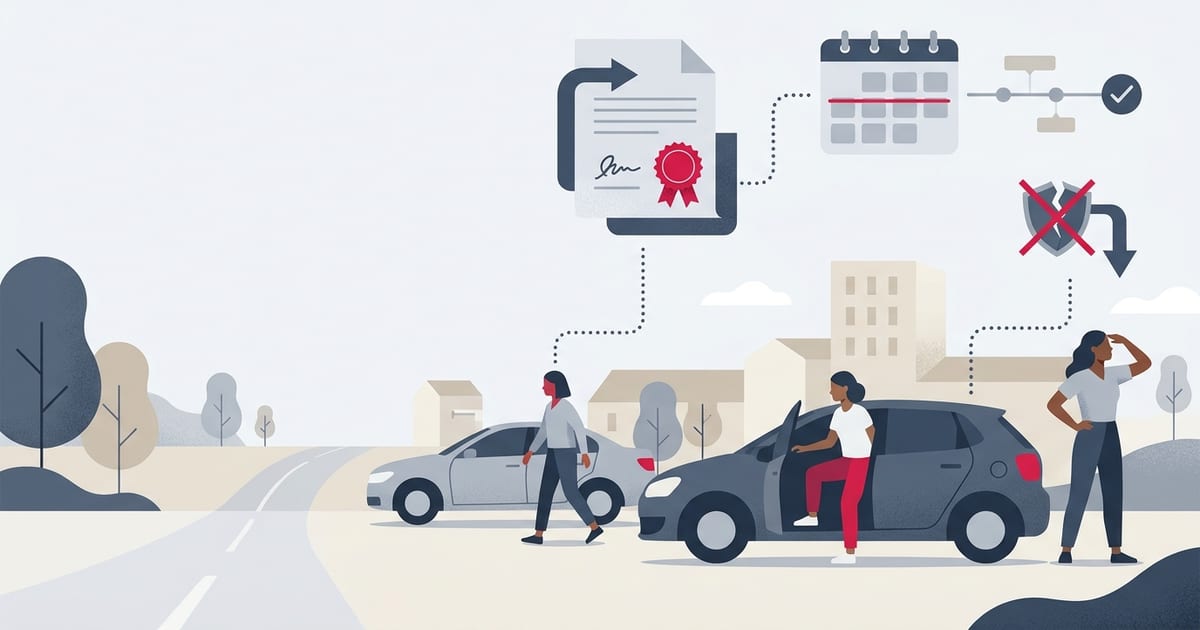
How it works
- 1
Buy a non-owner policy
From an insurer that writes SR-22 filings in your state.
- 2
Insurer files the SR-22
Electronically with the state licensing agency, usually the same day.
- 3
Reinstate your licence
Pay the state's reinstatement fee; the filing is confirmed on their end.
- 4
Keep it in force
Usually three years. Any lapse triggers a cancellation notice to the state.
- 5
Request removal
Once the period ends, ask the insurer to stop filing.
FR-44 states
Florida and Virginia use an FR-44 for alcohol-related offences, requiring higher liability limits than the standard minimum (Florida 100/300/50 under Fla. Stat. § 324.023; Virginia double the state minimum, which is 100/200/50 since the minimum rose to 50/100/25 in January 2025). Non-owner FR-44 policies exist and cost more because of the higher limits.
If you later buy a car
Tell the insurer before you take delivery. The non-owner policy will be converted to a standard owner policy and the SR-22 filing continues without interruption.
Entries in this guide
Specific questions answered in more depth.
Entry
Non-Owner SR-22 vs. FR-44: Statutory Rules, Limits, and Filings
Understand the differences between non-owner SR-22 and FR-44 insurance certificates, mandatory liability limits, filing durations, and reinstatement rules.
Entry
What Happens If Your Non-Owner SR-22 Policy Lapses?
Learn what happens when a non-owner SR-22 policy lapses, how state licensing agencies react, and the exact steps to reinstate coverage and restore your license.
Questions & answers
Can I get an SR-22 without a car?
Yes—through a non-owner SR-22 policy.
How long do I need the SR-22?
Typically three years, varying by state and offence.
What if I buy a car during the SR-22 period?
Convert the non-owner policy to an owner policy with the same insurer before driving it; the filing continues.
Terms used in this guide
- SR-22
- A certificate of financial responsibility filed by your insurer with the state after certain violations; typically required for three years.
- FR-44
- Florida's and Virginia's higher-limit filing for alcohol-related offences.
- Financial responsibility
- The legal obligation to show you can pay for crash damage, usually via liability insurance.
- Coverage gap (lapse)
- A period with no auto liability coverage; rated as a risk factor for several years.
Sources and references
Legal figures on this page (minimum limits, filing periods, statutory benefits) are checked against the primary law or the state insurance regulator listed below. Links and figures last verified Nov 2026.
- 37 TAC § 25.5 — enforcement of failure to maintain financial responsibility — Texas Administrative Code (via Cornell LII), 37 Tex. Admin. Code § 25.5Primary lawAn SR-22 filed as compliance must be maintained for two years from the most recent qualifying conviction; a lapse re-suspends driving privileges until a new certificate is filed.
- Va. Code § 46.2-316 — proof of financial responsibility after certain convictions — Virginia Law (LIS), Va. Code § 46.2-316(C)Primary lawAfter DUI-type convictions, proof must be at double the § 46.2-472 limits (the FR-44 requirement, currently 100/200/50) for three years after becoming eligible for a licence.
- Automobile financial responsibility limits by state — Insurance Information Institute (2023)Statistical dataCompulsory coverages and minimum liability limits by state (table dated December 2023 — several states have raised limits since; see statute entries).
- Facts + Statistics: Alcohol-impaired driving — Insurance Information InstituteStatistical dataAlcohol-impaired crash fatalities, BAC thresholds and state ignition-interlock context.
- Consumer insurance information — National Association of Insurance CommissionersConsumer guidancePlain-language guides from the body of state insurance regulators; links to every state's insurance department and complaint process.
- What if I can't find auto coverage? — Insurance Information InstituteConsumer guidanceHow the non-standard market and state assigned-risk plans insure drivers the voluntary market declines.
- Is it legal to drive without insurance? — Insurance Information InstituteConsumer guidanceEvery state requires drivers to demonstrate financial responsibility; in most states insurance is the mandatory way to do so.
- What is covered by a basic auto insurance policy? — Insurance Information InstituteConsumer guidanceDefines bodily injury and property damage liability, MedPay, PIP, uninsured/underinsured motorist, collision, comprehensive and glass coverage.
Practical guidance on this page is original editorial work. Cited sources support factual statements and do not endorse this site. Dollar ranges described as typical or illustrative are editorial estimates, not figures from these sources.
Guide
Who Needs Non-Owner Car Insurance
The situations where a non-owner policy makes sense: frequent borrowers, drivers maintaining coverage history, SR-22 filers without a car, and people between cars.
Guide
How Much Non-Owner Car Insurance Costs
Typical non-owner policy premiums by driver profile, why it is cheaper than a standard policy, and what raises the price.
Guide
How to Compare Non-Owner Car Insurance Quotes
A method for finding non-owner coverage: which insurers write it, how to ask, what limits to choose, SR-22 handling, and how to compare prices.