
Entry in Non-Owner SR-22 Insurance
Non-Owner SR-22 vs. FR-44: Statutory Rules, Limits, and Filings
Understand the differences between non-owner SR-22 and FR-44 insurance certificates, mandatory liability limits, filing durations, and reinstatement rules.

By Dana Whitlock · Staff Writer
Published
Answer in brief
A named non-owner insurance policy provides a legally recognised way to satisfy state-mandated certificate filings when you must restore your driving privileges without owning a car. While an SR-22 verifies that you maintain standard state financial responsibility limits, an FR-44 mandates significantly higher liability coverage following serious driving convictions. Both certificates require strict continuous coverage, as any lapse triggers immediate electronic notification to state licensing authorities and re-suspends driving privileges.
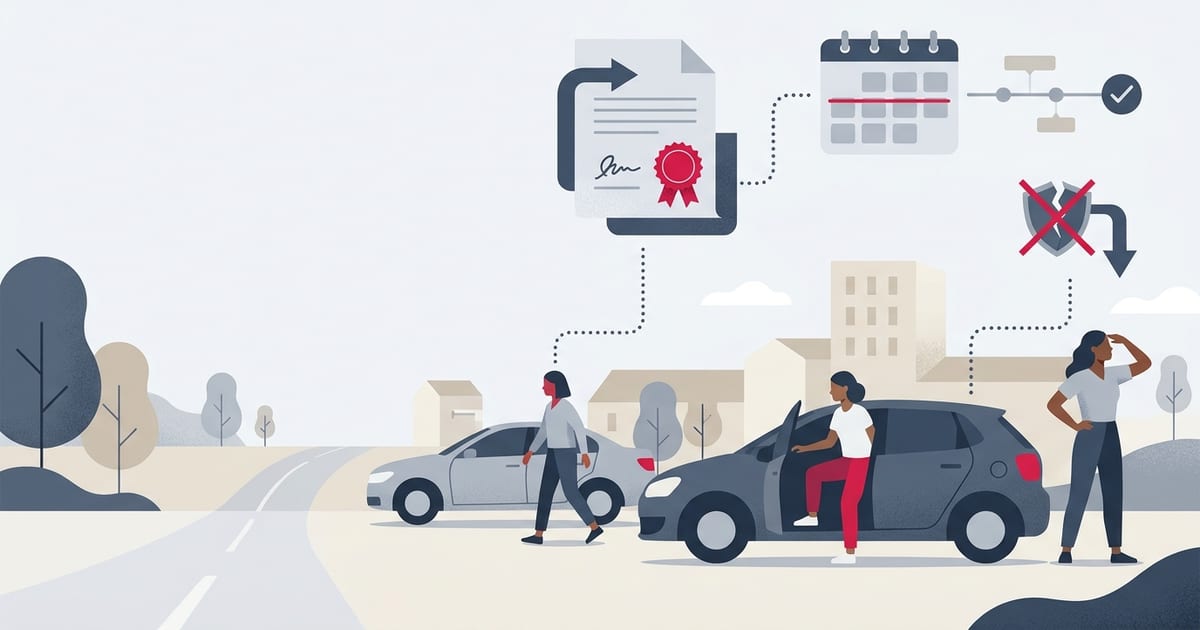
Certificate Mandates for Drivers Who Do Not Own a Vehicle
Every US state mandates that motorists prove financial responsibility before operating a motor vehicle on public roadways. When a driver incurs major traffic violations or license suspensions, the state licensing agency often requires formal verification that adequate coverage is in effect. Drivers who own vehicles attach these certificates to standard auto policies. However, individuals who do not own an automobile face a different challenge: they must purchase a named non-owner policy and request that the insurer file either an SR-22 or FR-44 endorsement on their behalf.
Neither an SR-22 nor an FR-44 is an independent insurance contract. Instead, both documents serve as state-mandated certificate filings attached to an underlying insurance policy. The filing certifies to state licensing authorities that the named driver maintains active liability coverage. For non-owners, this policy acts as a personal liability shield when driving borrowed or rented vehicles, ensuring third-party injury and property damages are covered up to the selected liability limits.
Comparing Non-Owner SR-22 and FR-44 Filings Side by Side
| Filing Dimension | Non-Owner SR-22 Certificate | Non-Owner FR-44 Certificate |
|---|---|---|
| Primary Statutory Purpose | Verifies baseline financial responsibility following license suspensions, uninsured driving, or repeat infractions. | Verifies elevated financial responsibility following serious alcohol- or drug-related driving convictions. |
| Mandated Liability Limits | Requires state standard minimum liability limits. | Requires double standard statutory limits; under Virginia Law (Va. Code § 46.2-316(C)), limits must reach 100/200/50. |
| Statutory Maintenance Term | Commonly two to three years; under Texas rule 37 Tex. Admin. Code § 25.5, compliance must be maintained for two years. | Three years from the date of license eligibility under Virginia Law (Va. Code § 46.2-316(C)). |
| Required Vehicle Status | Requires that the driver does not own a vehicle (and usually has no regular access to a household car). | Requires that the driver does not own a vehicle (and usually has no regular access to a household car). |
| Consequence of Policy Lapse | Carrier notifies licensing authority immediately; driving privileges are re-suspended. | Carrier notifies licensing authority immediately; driving privileges are re-suspended. |
Statutory Maintenance Durations and the Cost of Coverage Lapses
State statutes strictly govern how long a driver must maintain proof of financial responsibility. For instance, under Texas Administrative Code (37 Tex. Admin. Code § 25.5), an SR-22 filed as compliance must be maintained continuously for two years from the most recent qualifying conviction. If a lapse occurs at any point during that compliance window, the state licensing agency re-suspends driving privileges until a new certificate is submitted. In jurisdictions requiring an FR-44, such as Virginia under Va. Code § 46.2-316(C), the certificate must remain in force at 100/200/50 limits for three years after becoming eligible for a license.
Because state agencies track these certificates electronically, insurers are bound by statutory reporting requirements. If you cancel your non-owner policy, fail to remit renewal payments, or let the coverage expire, the insurer immediately files a cancellation notice (frequently an SR-26 or FR-46). State licensing authorities interpret this notification as an active violation of financial responsibility laws. In most jurisdictions, an unexcused lapse resets the multi-year compliance clock back to day one, extending your high-risk classification and multiplying long-term insurance expenses.
Steps to Secure and Submit Non-Owner Financial Responsibility
- 1
Confirm Your Exact State Requirement
Review your suspension notice or contact your state licensing agency to confirm whether your jurisdiction requires a standard SR-22 or an elevated FR-44, along with the precise statutory filing duration.
- 2
Shop Carriers in the Non-Standard Market
Because standard insurers frequently decline drivers needing certificate filings, seek quotes from carriers operating in the non-standard market that specialize in high-risk named non-owner policies.
- 3
Establish the Required Liability Limits
Instruct the insurer to establish coverage that meets statutory demands, such as the double-limit requirement of 100/200/50 under Virginia Law (Va. Code § 46.2-316(C)) when filing an FR-44.
- 4
Verify Electronic Transmission to the State
Pay the carrier's nominal filing fee and obtain an electronic filing confirmation number before attempting to complete license reinstatement procedures.
How Insurers Calculate High-Risk Non-Owner Premiums
Underwriting named non-owner coverage with an attached certificate involves standard auto pricing factors. According to the Insurance Information Institute, premiums reflect a motorist's driving record, estimated mileage, geographic territory, age, gender, coverage limits, and credit-based insurance scores. Regulators in some states restrict specific factors: ZIP-code rating is prohibited in California and Michigan, and gender rating is barred in seven states. Arkansas regulatory findings demonstrate that credit-based insurance scores lowered premiums on approximately 57 percent of auto policies and raised them on roughly 23 percent.
When a driver requires an SR-22 or FR-44, the primary cost driver is not the administrative certificate fee, which typically costs $15 to $50 as a one-time transaction. The underlying price increase stems from the driving violation that triggered the mandate. For standard drivers, an annual non-owner policy might cost between $250 and $500, but a driver with an SR-22 or FR-44 requirement often sees typical illustrative annual premiums between $550 and $1,400. In situations where the voluntary market refuses coverage entirely, drivers may access coverage through their state's assigned-risk plan to fulfill statutory compliance.
Questions & answers
Can I obtain an SR-22 or FR-44 certificate if I do not own a vehicle?
Yes. You purchase a named non-owner auto insurance policy and request that the insurer attach the SR-22 or FR-44 certificate filing, which is transmitted directly to your state licensing agency.
What is the primary difference between an SR-22 and an FR-44?
An SR-22 verifies standard state minimum financial responsibility limits. An FR-44 mandates significantly higher coverage limits, such as 100/200/50 under Virginia Law (Va. Code § 46.2-316(C)), and is usually required after major alcohol- or drug-related violations.
What happens if my non-owner SR-22 policy lapses?
The insurance company is legally required to notify the state licensing authority immediately. Under regulations such as 37 Tex. Admin. Code § 25.5, your driving privileges are re-suspended until a valid certificate is refiled.
Does a non-owner policy cover damage to a car I borrow?
No. A named non-owner policy provides only third-party liability coverage (bodily injury and property damage). It does not include collision or comprehensive coverage to pay for physical damage to the vehicle you are operating.
Terms: SR-22, FR-44, Liability limits, Continuous coverage, Non-owner (named non-owner) policy
Sources and references
Legal figures on this page (minimum limits, filing periods, statutory benefits) are checked against the primary law or the state insurance regulator listed below. Links and figures last verified Nov 2026.
- 37 TAC § 25.5 — enforcement of failure to maintain financial responsibility — Texas Administrative Code (via Cornell LII), 37 Tex. Admin. Code § 25.5Primary lawAn SR-22 filed as compliance must be maintained for two years from the most recent qualifying conviction; a lapse re-suspends driving privileges until a new certificate is filed.
- Va. Code § 46.2-316 — proof of financial responsibility after certain convictions — Virginia Law (LIS), Va. Code § 46.2-316(C)Primary lawAfter DUI-type convictions, proof must be at double the § 46.2-472 limits (the FR-44 requirement, currently 100/200/50) for three years after becoming eligible for a licence.
- Background on: Insurance scoring — Insurance Information InstituteIndependent researchWhat credit-based insurance scores are; Arkansas regulator data showing credit lowered premium on ~57% of auto policies and raised it on ~23%.
- Automobile financial responsibility limits by state — Insurance Information Institute (2023)Statistical dataCompulsory coverages and minimum liability limits by state (table dated December 2023 — several states have raised limits since; see statute entries).
- Is it legal to drive without insurance? — Insurance Information InstituteConsumer guidanceEvery state requires drivers to demonstrate financial responsibility; in most states insurance is the mandatory way to do so.
- What if I can't find auto coverage? — Insurance Information InstituteConsumer guidanceHow the non-standard market and state assigned-risk plans insure drivers the voluntary market declines.
- What determines the price of an auto insurance policy? — Insurance Information InstituteConsumer guidanceRating factors: driving record, mileage, location, age, gender, vehicle, credit-based insurance score, coverage choices. Notes ZIP-code rating is prohibited in California and Michigan and gender rating is prohibited in seven states.
- How much auto coverage do I need? — Insurance Information InstituteConsumer guidanceWhy state minimums are a floor; choosing liability limits that protect assets; when collision and comprehensive are worth keeping.
Practical guidance on this page is original editorial work. Cited sources support factual statements and do not endorse this site. Dollar ranges described as typical or illustrative are editorial estimates, not figures from these sources.
Entry
What Happens If Your Non-Owner SR-22 Policy Lapses?
Learn what happens when a non-owner SR-22 policy lapses, how state licensing agencies react, and the exact steps to reinstate coverage and restore your license.
Parent guide
Non-Owner SR-22 Insurance
How to meet an SR-22 or FR-44 filing requirement without owning a car, what the filing does, how long it lasts, and what happens if the policy lapses.