
Entry in Non-Owner SR-22 Insurance
What Happens If Your Non-Owner SR-22 Policy Lapses?
Learn what happens when a non-owner SR-22 policy lapses, how state licensing agencies react, and the exact steps to reinstate coverage and restore your license.

By Dana Whitlock · Staff Writer
Published
Answer in brief
When a non-owner SR-22 policy lapses, your insurer is legally required to notify your state licensing agency, triggering an immediate suspension of driving privileges. In states like Texas, financial responsibility must be maintained continuously for two full years from conviction, meaning any lapse resets your timeline and adds reinstatement penalties. Understanding the cancellation process and acting immediately with a new filing protects your license and prevents escalating insurance costs.
Understanding the Mandatory Notification Process
An SR-22 is not an insurance policy on its own; it is a formal certificate of financial responsibility attached to an auto policy and transmitted directly to your state licensing agency. When you purchase a non-owner policy with an SR-22 filing, the insurance company enters into a legal obligation with the state to monitor the policy's status.
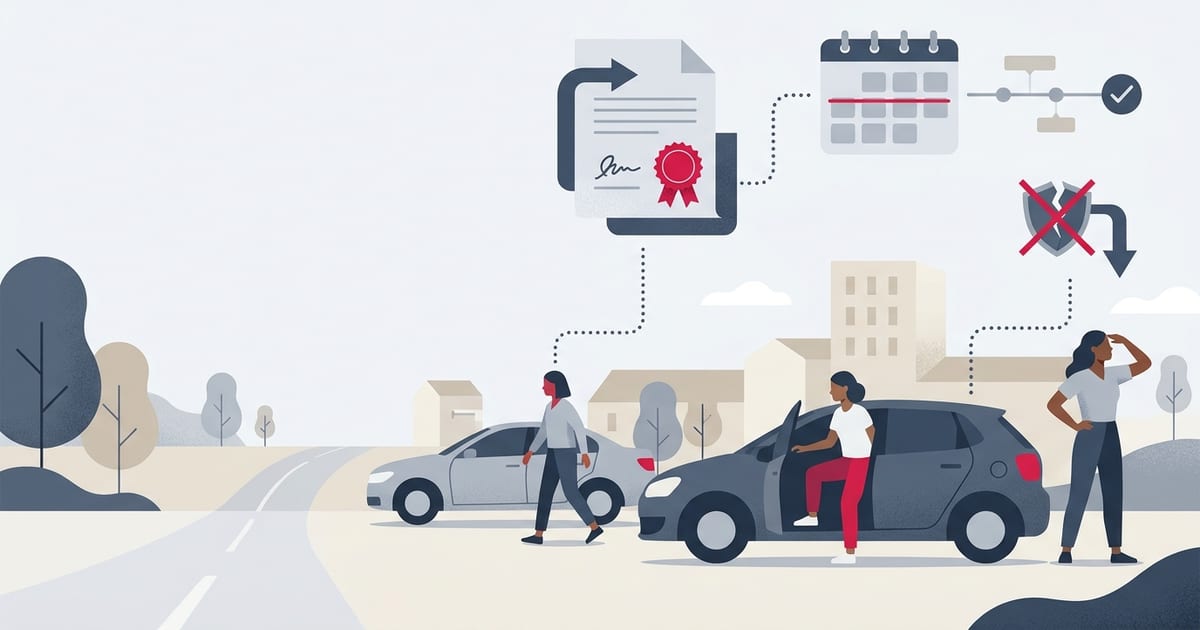
If the policy cancels for non-payment, lapses at renewal, or is terminated for any reason, the insurer cannot simply close the file quietly. State regulations mandate that the insurer generate an electronic cancellation notice—frequently designated as an SR-26 form—and transmit it directly to the state licensing agency. Once received, the licensing authority matches the cancellation to your driver record and initiates automated enforcement actions.
State Suspension and Reinstatement Clock Resets
The most immediate and severe consequence of an SR-22 lapse is the suspension of your driving privileges. Under Texas Administrative Code (37 TAC § 25.5), an SR-22 filed as compliance must be continuously maintained for two years from the most recent qualifying conviction. When a lapse occurs, state regulations dictate that driving privileges are re-suspended until an acceptable replacement certificate is filed.
In many jurisdictions, the statutory compliance clock resets entirely if an unexcused lapse occurs. For instance, if you were required to maintain proof of financial responsibility for twenty-four consecutive months and allowed the policy to lapse at month twenty-two, the state licensing agency may require you to begin a brand-new two-year compliance cycle from the date your new filing is accepted. Similarly, in states enforcing elevated certificates such as the Virginia FR-44 under Va. Code § 46.2-316(C), three years of uninterrupted coverage at double statutory limits are required; any interruption invalidates compliance.
The Compounding Financial Penalties of an Uninsured Lapse
As emphasized by the Insurance Information Institute, every state requires drivers to demonstrate financial responsibility, and insurance is the standard mechanism to do so. Allowing a non-owner SR-22 to lapse triggers multiple financial penalties that compound quickly:
First, operating any borrowed or shared vehicle during an active suspension results in severe statutory penalties, vehicle impoundment, and potential misdemeanor charges on your driving record. Second, state licensing agencies assess administrative reinstatement fees, often running into hundreds of dollars, before restoring driving eligibility. Third, the cancellation creates a formal coverage gap, which underwriters penalize heavily.
Step-by-Step Guide to Resolving an SR-22 Policy Lapse
- 1
Contact Your Prior Insurer Within Any Available Grace Period
If your payment was missed recently, contact your insurer immediately. Some carriers provide a narrow grace period where paying overdue balances reinstates the policy without sending an SR-26 cancellation to the state.
- 2
Request New Quotes from Non-Standard Insurers
If your prior carrier has finalized cancellation, shop immediately among non-standard insurers who handle high-risk filings. Visit our SR-22 non-owner hub to understand state filing rules.
- 3
Confirm Immediate Electronic Certificate Transmission
Ensure the new carrier submits the electronic SR-22 filing directly to your state licensing agency upon policy inception so the compliance transmission is officially logged.
- 4
Pay State Administrative Reinstatement Fees
Check your driver record via your state licensing agency online portal to determine what outstanding fees must be settled to clear the administrative suspension.
- 5
Verify Full License Reinstatement Before Driving
Do not drive any vehicle until your state licensing agency confirms that your driving record displays a valid, active status.
Accessing Coverage When Standard Carriers Decline
When a driver experiences an SR-22 cancellation, voluntary market insurers may decline application requests. The Insurance Information Institute notes that when drivers cannot secure coverage through voluntary channels, they can obtain liability insurance through non-standard specialty carriers or state assigned-risk plans.
State assigned-risk mechanisms guarantee that every licensed driver has access to basic financial responsibility coverage, ensuring you can satisfy statutory requirements even after multiple infractions. Once a new policy is bound and filed, maintaining uninterrupted monthly premium payments protects your license status until your multi-year filing obligation expires.
Questions & answers
Will my driver's license be suspended immediately if my non-owner SR-22 lapses?
Yes. When an insurer terminates an active SR-22 policy, it files an electronic cancellation notice with the state licensing agency. Upon processing this notice, the state automatically suspends your driving privileges until a replacement certificate is verified.
Does an SR-22 lapse reset my multi-year filing requirement?
In many states, yes. For example, Texas Administrative Code (37 TAC § 25.5) requires continuous financial responsibility for two years from the qualifying conviction. An unexcused lapse re-suspends driving privileges, and state rules often require the driver to restart the full filing period.
Can I drive someone else's car while my SR-22 is lapsed?
No. Driving any vehicle while your license is suspended for a financial responsibility lapse is illegal. If caught, you face severe statutory penalties, citations, and extended suspension periods.
How quickly can a new non-owner SR-22 policy restore my license?
Many non-standard insurers can issue a policy and electronically transmit the SR-22 certificate to your state licensing agency within 24 to 48 hours. Once the agency receives the filing and administrative fees are paid, your license is cleared for reinstatement.
Terms: SR-22, Financial responsibility, Non-owner (named non-owner) policy, FR-44, Coverage gap (lapse)
Sources and references
Legal figures on this page (minimum limits, filing periods, statutory benefits) are checked against the primary law or the state insurance regulator listed below. Links and figures last verified Nov 2026.
- 37 TAC § 25.5 — enforcement of failure to maintain financial responsibility — Texas Administrative Code (via Cornell LII), 37 Tex. Admin. Code § 25.5Primary lawAn SR-22 filed as compliance must be maintained for two years from the most recent qualifying conviction; a lapse re-suspends driving privileges until a new certificate is filed.
- Va. Code § 46.2-316 — proof of financial responsibility after certain convictions — Virginia Law (LIS), Va. Code § 46.2-316(C)Primary lawAfter DUI-type convictions, proof must be at double the § 46.2-472 limits (the FR-44 requirement, currently 100/200/50) for three years after becoming eligible for a licence.
- 14 percent of U.S. drivers were uninsured in 2022 — Insurance Research Council (2023)Independent researchAbout one in seven drivers was uninsured in 2022; highest D.C. 25.2%, New Mexico 24.9%, Mississippi 22.2%; lowest Wyoming 5.9%, Maine 6.2%, Idaho 6.2%. Method: ratio of UM to BI claim frequencies.
- Estimated percentage of uninsured motorists by state, 2017–2023 — Insurance Information Institute (2025)Statistical dataIRC time series by state; 2023: Mississippi 28.2%, New Mexico 24.1%, D.C. 23.1%, Michigan 22.3%, Florida 20.6%, California 20.4%, Texas 14.5%; lowest Maine 5.7%.
- Is it legal to drive without insurance? — Insurance Information InstituteConsumer guidanceEvery state requires drivers to demonstrate financial responsibility; in most states insurance is the mandatory way to do so.
- What if I can't find auto coverage? — Insurance Information InstituteConsumer guidanceHow the non-standard market and state assigned-risk plans insure drivers the voluntary market declines.
- What determines the price of an auto insurance policy? — Insurance Information InstituteConsumer guidanceRating factors: driving record, mileage, location, age, gender, vehicle, credit-based insurance score, coverage choices. Notes ZIP-code rating is prohibited in California and Michigan and gender rating is prohibited in seven states.
- Consumer insurance information — National Association of Insurance CommissionersConsumer guidancePlain-language guides from the body of state insurance regulators; links to every state's insurance department and complaint process.
Practical guidance on this page is original editorial work. Cited sources support factual statements and do not endorse this site. Dollar ranges described as typical or illustrative are editorial estimates, not figures from these sources.
Entry
Non-Owner SR-22 vs. FR-44: Statutory Rules, Limits, and Filings
Understand the differences between non-owner SR-22 and FR-44 insurance certificates, mandatory liability limits, filing durations, and reinstatement rules.
Parent guide
Non-Owner SR-22 Insurance
How to meet an SR-22 or FR-44 filing requirement without owning a car, what the filing does, how long it lasts, and what happens if the policy lapses.